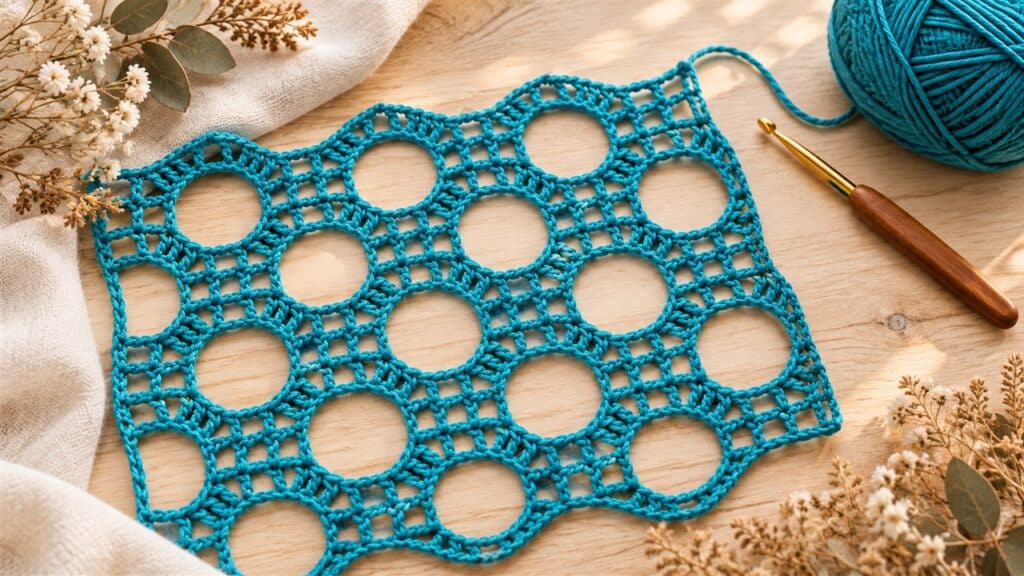
This easy Tunisian crochet mesh stitch creates a light fabric with orderly vertical eyelets separated by textured horizontal ridges. The pattern looks clean in a solid color and can be used for scarves, wraps, lightweight blankets, market bags, cushion panels, or breathable garment sections. A long Tunisian hook holds the live loops while each row is worked in a forward pass and a return pass.
This English guide accompanies the embedded video tutorial. It explains the structure, preparation, technique, tension tips, edge control, and project ideas. Use the video as the primary source for the designer’s exact stitch multiple, hook placement, yarn overs, and row sequence.
Easy Tunisian Crochet Mesh Stitch Video Tutorial
What Is Tunisian Crochet?
Tunisian crochet combines familiar crochet motions with a long hook that holds multiple loops. Most rows have two stages. During the forward pass, loops are picked up across the fabric and left on the hook. During the return pass, those loops are worked off in sequence. The project is not usually turned after every row unless the tutorial specifically instructs you to do so.
This method creates fabric with distinctive vertical bars and defined rows. In a mesh variation, deliberate spaces are added to reduce density and create a repeating openwork effect. The result has more drape and airflow than a solid Tunisian stitch.
Suggested Materials
- A smooth light-colored yarn for learning the stitch
- A Tunisian crochet hook long enough for the desired width
- A hook with cable for wider blankets or garments
- Scissors and a yarn needle
- Stitch markers for the first and last stitches
- A ruler or tape measure for checking gauge
A smooth yarn makes the vertical bars and eyelets easier to identify. Avoid highly fuzzy or novelty yarn while learning because it can hide the insertion points. Tunisian crochet fabric often works best with a hook slightly larger than the size normally used for the same yarn, helping prevent stiffness and excessive curling.
Understanding the Mesh Pattern
The swatch alternates solid horizontal structure with evenly spaced openings. Each eyelet should remain aligned with the eyelets above and below it. That alignment depends on following the correct repeat and recognizing which loops or vertical bars are skipped, combined, or replaced with yarn overs.
Count the loops on the hook at the end of every forward pass. The number should remain consistent unless the tutorial intentionally increases or decreases. If the count changes unexpectedly, examine the current row before working the return pass.
Step-by-Step Technique Overview
- Make the foundation chain. Use the stitch multiple and additional edge chains stated in the video.
- Pick up foundation loops. Insert the hook in the demonstrated part of each chain and retain every loop.
- Work the first return pass. Follow the tutorial carefully, especially for the initial chain and paired loop closures.
- Establish the edge stitches. Keep the first loop stable and work the final stitch through the correct edge strands.
- Begin the mesh repeat. Alternate the required stitch placements, spaces, and yarn overs across the row.
- Count the live loops. Confirm the repeat ends correctly before beginning the return pass.
- Complete the return pass. Work loops off the hook without tightening them excessively.
- Repeat the pattern rows. Watch the vertical alignment of eyelets and the width of the swatch.
- Finish with a closing row. Use a slip-stitch-style bind-off or the finishing method demonstrated.
- Block the fabric. Shape gently according to the yarn’s care instructions.
How to Keep Tunisian Crochet Edges Straight
The final stitch of the forward pass is a common trouble spot. Insert the hook through the edge strands shown in the video so the side has enough structure. Missing one strand can create a loose edge, while inserting into the wrong space may add a stitch.
Place a marker near the final stitch until the edge anatomy becomes familiar. Count after each forward pass and compare both sides of the fabric. If the swatch narrows, a loop is probably being missed. If it widens, an extra loop may be picked up near an eyelet or edge.
Managing Tension and Curling
Tunisian crochet tends to curl because the stitches place tension on the front of the fabric. Use a larger hook, keep the foundation chain relaxed, and avoid pulling the return pass too tightly. A border and gentle blocking can reduce remaining curl.
Spread the loops along the shaft or cable rather than compressing them near the hook head. Each loop should have enough height to be worked comfortably on the next pass. Consistent loop height produces even ridges and uniform openings.
Making Clean, Consistent Eyelets
Pay attention to the relationship between yarn overs and skipped or combined stitches. An eyelet is not simply an empty space; it must be balanced so the total stitch count stays correct. After completing a repeat, pause and compare it with the previous section.
Solid light yarn makes mistakes easier to see. Once the pattern feels comfortable, try a gentle gradient or alternating colors. Strong striping can emphasize the horizontal ridges, while a tonal yarn creates a softer texture.
Choosing Projects for Tunisian Mesh
The open fabric is well suited to warm-weather scarves, shawls, wraps, market bags, airy tops, table runners, and blanket panels. For a bag, use a lining if small objects could slip through the openings. For garments, make a generous gauge swatch and test the fabric after washing.
To create a wider project, repeat the stated stitch multiple. For additional length, continue the pattern rows until the measurement is reached. Remember that blocking may change both width and length, particularly with plant fibers or wool.
Color and Yarn Ideas
Warm cream highlights the stitch definition and suits minimalist home décor. Dusty rose, sage, and terracotta create a modern earthy palette. Cotton produces a crisp breathable fabric, acrylic can be practical and washable, and wool blends add warmth and elasticity.
If changing colors, introduce the new yarn at a consistent stage of the return pass for clean horizontal stripes. Leave secure tails, weave them through dense areas, and avoid carrying contrasting yarn where it can show through the mesh.
Common Problems and Fixes
Why is my stitch count changing?
A loop may be missed at the edge, or an extra loop may be picked up beside an eyelet. Count after every forward pass and mark the final stitch.
Why are the openings uneven?
Uneven loop height, tight yarn overs, or inconsistent return-pass tension can distort the eyelets. Slow down and keep the working yarn relaxed.
Why is the fabric stiff?
The hook may be too small or the tension too tight. Try a larger Tunisian hook and make a new swatch before continuing.
Can I use a regular crochet hook?
A standard hook may work for a very narrow sample if it has no restrictive thumb grip, but a Tunisian hook is more comfortable and provides room for all live loops.
Finishing and Blocking
Work a neat closing row so the last set of loops is secured without creating a loose chain across the top. Weave in ends through several stitches and change direction once. Block the swatch to open the mesh, straighten the edges, and relax minor curling.
Save the vertical tutorial image to Pinterest so this Tunisian crochet mesh stitch is easy to find for your next scarf, wrap, blanket, or lightweight home décor project.